Riding the Congo Nile Trail: A Journey of Discovery
It is something of an understatement to say that Rwanda has a chequered history.
Depending on their age, people either know about it because of the Genocide of 1994, or as the country where the UK government was planning to send refugees. There are also the Arsenal Football supporters who know of it from the Club’s “visit Rwanda” sponsorship emblazoned on the sleeve of their player’s kit.
When I speak to people about Rwanda, very few know where it is, often not even knowing that it is in Africa.
It has a tempestuous history from being a German colony before the First World War, following which it became a Belgian colony. Independence was granted in the early 60’s and then the country seemed to be in a continual on and off state of civil dispute culminating in the Genocide of 1994. Briefly, in 10 weeks from the start of April 1994, 1,000,000 people were massacred. Clearly, it scarred the country. Those scars remain and 2024 was the 30th year of remembrance and this was clear throughout the Country, with huge boards and signs everywhere encouraging everyone to remember.

I first went to Rwanda many years ago as a charity worker and barring Covid have been at least once every year since. I am one of seven ordinary working people who are the Trustees of a small sports-based charity, Friends Of Rwandan Rugby (FoRR), operating in Rwanda whose raison d’etre is to help with community cohesion using rugby as the vehicle. Rugby is a ‘post genocide’ sport and therefore has no pre-genocide ethnic divisions.
Rwanda is a beautiful country, known as the Land of a Thousand Hills, although there are many more than that. Our charity works all over the country and as a result I have seen a great deal of it, but only from a bus. As a charity, we maximise our time and have little opportunity to see and explore the wider countryside. It is the most densely populated country in Africa, only a little bit bigger than Wales, yet has a population of 12.5 million, compared to 3 million in Wales. The Rwandan population is youthful, the median age, just 19.7 years, so you are never very far from a friendly, enthusiastic and helpful Rwandan.
Every time I have visited Rwanda on behalf of FoRR, I have promised myself a return trip to explore further. I had heard of the Congo Nile Trail and discovered that it runs the length of the Country from North to South almost following the shores of Lake Kivu. Returning home from there in September 2023, I started to put things in place for a return motorcycle expedition and together with a few friends drew up some plans. Word spread and more friends were recruited, including another Charity trustee and my son Joe.
Joe, being the techie, sorted the off-road element of the route. A Rwandan friend, Claude, was employed as an in-country guide, his role being mainly as interpreter and back stop in case of emergencies. I am a Mountain and Jungle Expedition Leader, but this was my first motorcycle tour.
The ideal bike for our trip was the Haojin Hawk 200cc, hired locally. It is a single cylinder trail bike with modern touches, such as electric start, single rear shock and USD forks. However it had no water-cooling and no fuel injection – a blast from the past with a carb and a choke. It proved to be nice to ride, enough performance for Rwandan roads and speed limits in built up areas of 60kmh and on open roads, 80kmh. I found it robust, reliable, economical and comfortable.
The trip was timed to start at the end of one of our charity tours, so a few of the travellers were already in Rwanda. The bikes were collected and we convened at the accommodation to load them up. Everyone was advised to travel light as we had no support vehicle. I had researched the locations of hospitals and medical centres, in case of any emergencies. I also briefed everyone that Rwanda is a developing country with no Air Ambulances, no mountain rescue teams and that we had to rely mainly on ourselves. I carried emergency supplies, a stretcher and comprehensive first aid kits. We would all have had to deal with any emergency situation, so it was imperative for everyone’s enjoyment that we all rode sensibly, taking no silly risks, no riding beyond ability. If anyone felt unable to tackle an obstacle or some difficult terrain off road, we had experienced riders who would assist.
On arriving with the bikes at our accommodation, we loaded up and discovered that one of them had a slow puncture, whilst I did have the means to repair it, I decided to see how quickly a replacement bike could be sorted. As it turned out, much quicker than I could repair the bike. The replacement bike was not one of the mighty Haojin Hawks but an even mightier Zongsheng Cyclone 300. This bike has an air-cooled 300cc engine and came complete with panniers, a top box and worryingly road-based tyres. It looked for all the world like an Adventure bike, sharing the ‘beak’ that is so common to the genre. Fuelled and loaded the Cyclone felt heavy compared to the mountain goat that is the Haojin Hawk. I was in a dilemma with this bike and not knowing the ability of many of the other riders, I gave my Hawk to replace the punctured bike and rode the Cyclone. In some respects, this turned out to be a wise choice as the carrying capacity of the Cyclone was greater and it had a proper pillion seat, should we have needed it. The downside was its weight and road-based tyres, but this was Rwanda, the main source of transport being the 125/150cc moto taxis on road tyres that seemingly go almost anywhere! So, when in Rome……..
Like many similar cities with a different road culture to Europe, Kigali is crazy and chaotic. You need eyes everywhere, traffic seems to come at you from all directions, even more so on roundabouts, yet it seems to work and it is tremendous fun. Trying to keep nine riders together in Kigali was going to be a challenge, we had six experienced riders and three relatively inexperienced riders in the group, so to leave the city initially I tried to work in three groups, each having a rider who knew Rwanda. This fell by the wayside within minutes in the chaos of Kigali and we ended up with a group of six and a group of three. I stayed with the inexperienced riders. As is the way in our technology laden world, we set up a WhatsApp group, then if or when we did get separated, we could find each other easily. The data network in Rwanda puts the UK to shame, there are areas of the town where I live in the UK where the signal is non-existent, yet in the middle of the remotest parts of Africa the signal is good!
The speed limit on the open road in Rwanda is 80kmh and in ‘built up areas’ 60kmh, no one is rushing around. This is just as well because the scenery is stunning and around every corner is a photo opportunity. Other road users are interesting too. On all the hills, cyclists on, brightly coloured, sit up and beg, bikes with rod brakes, hang illegally onto the backs of slow-moving lorries to get up the hills. Pedestrians can often be seen hanging off the backs of lorries as they hitch a lift too. A good tip is not to ride either too close or directly behind one of these combinations. When lining up for an overtake on one occasion, a towed cyclist lost control and fell off his bike taking a couple of others with him. It was a near miss for me.
There is nothing, it seems, that Rwandan bicycles cannot carry – livestock, milk churns, even furniture. I saw a six foot wide wooden bench being carried on one of them. These bikes are true beasts of burden. Watching them being towed was fascinating, but we had to look out on the downhills, because they flew. The riders crouching down in true Tour de France style, often travelling as fast as we were on motorbikes and occasionally faster.
One of the more unnerving challenges were the overtaking lorries and buses, usually coming up hills, which were fully on the wrong side of the road. These vehicles usually travel very slowly, overtaking even slower vehicles. Due to the lower speed limits, with everyone travelling slower, there is plenty of time to take avoiding action and eventually you just get used to it. In Rwanda you are travelling either up or down a hill and the climb from the main Kigali road rewards you with some amazing scenery. Stopping to look back at Kigali, which itself is built on hills, is quite a view.
The journey to Musanze was littered with incredible scenery, and we were cheered and waved at almost incessantly by curious locals. We travelled on a Sunday, so we were greeted in a couple of villages with church processions. These are lengthy and very colourful affairs, the sheer number of people forced the traffic to stop.
Musanze, where we met up with our in-country guide, Claude, is a vibrant and relatively wealthy district. This is because it is the volcano and Mountain Gorilla area and hence flush with tourists. It is possible to go and see the Gorillas in the wild and get very up close and personal, for the princely sum of $1500 (no, this isn’t a typo). Claude is a close friend; he used to work for our charity and his English is excellent. We all travelled together to the city of Gisenyi, which is close to both the Ugandan and DRC borders and is the start of the Congo Nile trail. Kigali to Gisenyi is just under 100 miles, but with reasonable stops takes the best part of four and a half to five hours. Gisenyi sits at the top of Lake Kivu and
the road down into the city affords views across and along the lake. There are several hotels overlooking the lake and the sunsets across the DRC are a sight to behold.
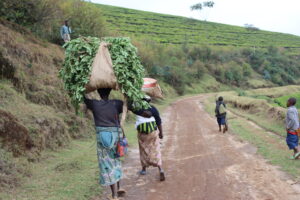
Being June and near the equator the weather is, unsurprisingly, delightful, and often not unbearably hot, especially on a motorbike. The start of the trail is not easy to locate as there is a lot of road construction ongoing. The trail seems to have three routes, a hiking trail, a cycling trail, and a road trail. All of which follow the edge of the lake south. The cycling trail is the one we sought. These are literally unpaved tracks of varying quality, which do suffer from damage during the monsoon season. However, whilst there are technical parts, it is not beyond the ability of a competent road rider. Additionally, the speeds are low due to the nature of the terrain, the country, and the distracting views.
Once the trail is located the environment changes, this is a developing country and its rural population lives simply, often surviving on what they can farm themselves. Compared to the UK the cost of living is low and the standard of living is much more basic. Many people do not have any form of transport, bicycles and small motorbikes making up the bulk of personal transportation. This was even more apparent on the trails, often on entering villages the children and young people swarmed towards our bikes. This is definitely one of the friendliest countries I have been to, and my waving arm was getting tired pretty early on.
The views of the countryside and lake are unspoiled as the trail moves away from the roads and the towns. On the trail, the scars of monsoons are evident. We saw channels created in the roads which go un-repaired, washed away bridges and landslides. None of these things happen during the dry season but are interesting challenges and add to the adventure.
One such village experienced a landslide, and people were waving for us to stop to tell us that our route was impassable. I had to investigate and discovered a huge landslide and a massive hole where the track was meant to be. About 100 yards further on the track could clearly be seen but was unreachable on motorbikes from where we were. All part of the adventure!
We sought another route and discovered that the trails following the lake are labyrinth like, making it difficult to keep in what we perceived as the right direction. We needed to head mainly south, but found ourselves heading north, or worse still, north-east which was disconcerting. We found a route around the landslide only to discover another landslide, albeit not one that affected our ‘new’ route. Some villages had constructed concrete channels across the gaps in the road, maybe about 10ft wide and easy to walk across or around, but no good for bikes. We had to fashion our own bridge from sticks and logs.
Passing through one village we were stopped because the bridge was down and locals guided us between huts, through bushes and along little trails to ride across the river estuary at the lake-side. Back tracking to have a look at the bridge we could see it had been completely washed away.
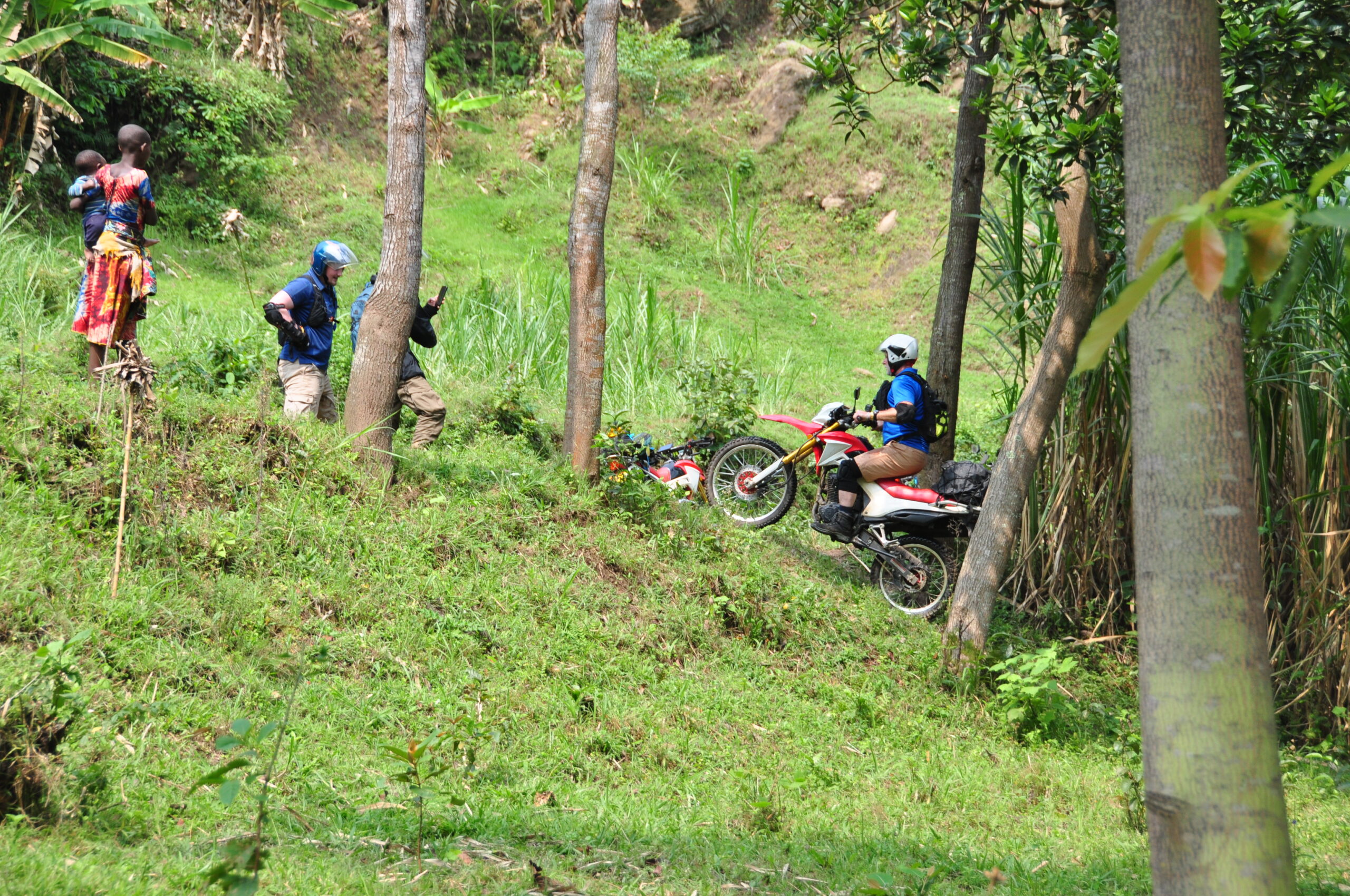
The biggest challenge was crossing a 100ft wide gorge, it was only about 10 or 15 feet down, but the bikes had to be carried down and up the other side. In no time at all there were too many, enthusiastic local hands offering to help.
We came across several impassable bridges, but these challenges formed part of the adventure. Two instances spring to mind, because they made me smile. One was when we came across a reasonably solid bridge with loose, haphazardly placed, wooden slats to ride across. On hearing us coming, a large group of children rushed to the bridge, rearranged the slats and found extra wood to make our crossing passable. It was very heart warming.
On another occasion we came across a solitary tree trunk spanning a river – not something I was going to ride across, although it may have been feasible for the more talented off roader. Crowds warned us that the river crossing was impassable, but we decided to just ride through the river, not something the locals had considered as an option. The lesson learned; always best to look for yourself!
Our perspective of what was an obstacle changed pretty quickly. There were water channels everywhere, easily more than one every couple of miles. Tree trunks were laid across them and we crossed the first few with trepidation, stopping, looking, and tentatively riding across and waiting for each other. As the day wore on and our faith and confidence grew, we just picked our line and went for it.
There were some steep climbs and descents, and it was occasionally tricky, but the Mighty Hawk was up to the task and a joy to ride. My even mightier Cyclone was less suited to the task, but more off-road biased tyres would have helped enormously. Nevertheless, the bikes did the job and we reached the end of the Congo Nile Trail in Cyangugu after four days of largely off road riding.
The next day was all road riding, to and then through the Nyungwe rainforest and again, at the risk of sounding repetitive, the views around every corner, and there were a lot of corners, were incredible. This is a road where you need to ride and savour the views, turn around, go back and savour the views in the other direction and then ride the road!
The final leg was from Huye to Kigali, all road, but interesting to ride, culminating in the madness of Kigali contrasting with the relative tranquility of the trails. It was completely different to where we had just been, but enjoyable in a different way, I loved riding around Kigali.
Everyone in the group had a great time and felt they had been on a genuine adventure. The riders were of mixed abilities, and all were able to cope with the terrain. The tour was not about racing along, it could have been completed in half the time if it were just about riding a bike. The point of the trip was the adventure. One of the riders has since described it as a life-changing experience and he had completed several bike tours in various parts of the world. The bikes were surprisingly good, the route, the people and the country of Rwanda were amazing. It has inspired me to start regular bike tours in Rwanda.
If you want a proper adventure message me at mike@riding-rwanda.com